In the Spotlight Trend of the Month
US tech stocks have produced phenomenal returns for investors in recent years. Powered by the artificial intelligence (AI) boom, shares in industries such as cloud computing and semiconductors have soared, driving the S&P 500 and Nasdaq 100 Indexes to record highs.
Recently, however, this area of the market has come under a little bit of pressure, and some experts believe that there could be more weakness to come as valuations remain high.
So, what are some diversification strategies to protect against a potential downturn in US tech stocks?
A powerful diversification tool
When it comes to portfolio diversification, it can pay to focus on asset correlation. This is a metric that shows the degree to which two assets move in relation to each other. It’s measured on a scale of -1.0 to +1.0. If two assets have a correlation of +1.0, it means they move in perfect tandem with one another while if two assets have a correlation of -1.0, it means they move in opposite directions to each other. By combining assets that have a low/negative correlation to each other in a portfolio, investors can potentially reduce the risk of experiencing big losses. If one asset experiences poor performance, losses may be offset by better performance in the other asset.
Europe has banks, defence, and much more
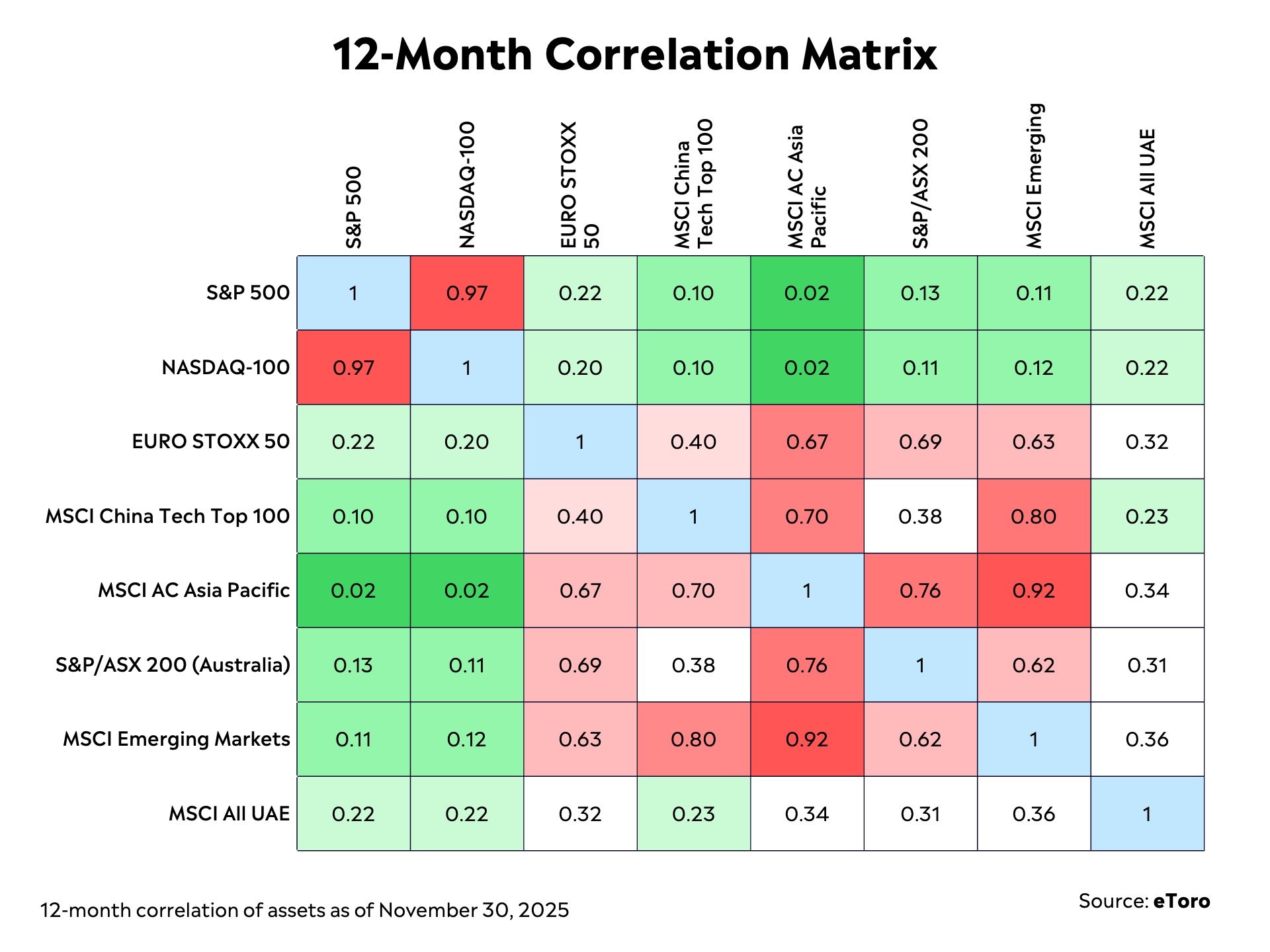
Now, one market that has a low correlation to US tech stocks is Europe. Currently, the Euro Stoxx 50 Index has a 12-month correlation of 0.22 with the S&P 500 and 0.20 with the Nasdaq 100, meaning that its performance is very independent of that of the US indexes. As for why the correlation here is so low, it comes down to the composition of the indexes. Whereas the US stock market is dominated by technology stocks (the Magnificent 7 represents about 35% of the S&P 500 today), the Euro Stoxx 50 has a lot of exposure to industrial companies, banks, and consumer goods businesses. It’s worth pointing out that Europe is home to many world-class companies. Some examples include music streaming giant Spotify, payments specialist Adyen, and aerospace powerhouse Airbus. It also has a thriving defence industry. This is benefitting from increased defence spending by NATO countries and looks well placed for further growth in the years ahead.
The emerging markets are growing quickly
Another area of the market that has a low correlation to the US indexes is the emerging markets. These are less-developed nations such as China, Brazil and India. Today, the MSCI Emerging Markets Index has a 12-month correlation of 0.11 with the S&P 500 and a correlation of 0.12 with the Nasdaq 100. So again, they are almost completely independent of one another. Here, there are a few factors behind the low correlation. One is sector weightings – emerging markets have more exposure to financials and industrials than the US indexes do. Another is economic drivers. Compared to the US market, emerging markets stocks are more influenced by local economic policies, commodity prices, global trade volumes, and sentiment-driven capital flows. One thing that the emerging markets have going for them is rapid economic expansion – many countries are growing much faster than developed countries such as the US, the UK, and Japan. Another is rising middle classes – this is fuelling consumption in areas such as retail, travel, and luxury goods.
China has its own technology
Zooming in on the emerging markets, one country in particular that is worth highlighting is China. What’s interesting about China is that, like the US, it is a technology powerhouse. Today, it’s a global leader in fields such as AI and self-driving vehicles. Yet, it has a very low correlation to the US tech sector. Currently, the 12-month correlation between the MSCI China Tech Top 100 and the Nasdaq 100 is just 0.10. As for what’s behind this low correlation, it’s the fact that the performance of Chinese tech companies is heavily influenced by Chinese economic growth and consumer spending and Chinese government policy (including regulatory crackdowns). In contrast, US tech companies tend to be influenced by US enterprise spending, global expenditures on technology, and US interest rates. So, the two markets have very different drivers.
Other markets worth exploring
Looking beyond these markets, some other more niche markets that could potentially help to diversify away from US tech stocks include:
Australia – The Australian economy is dominated by banks and mining companies, so its stock market looks nothing like the US market.
The Nordics – The Nordic region is home to a diverse mix of companies ranging from old economy businesses such as Swedbank and Volvo to innovators such as Spotify.
The Asian Dragons – The Asian Dragons (or "Four Asian Tigers") refers to South Korea, Taiwan, Hong Kong, and Singapore – four highly developed economies in East Asia.
The UAE – A region ignored by many investors, the UAE is home to a range of companies including oil, banking, and retail businesses.